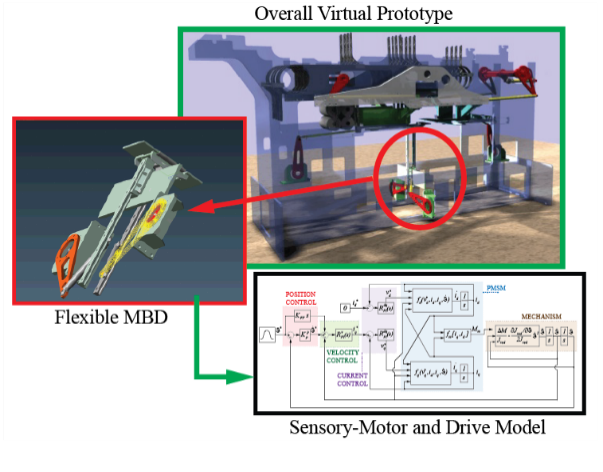

The fields of research developed in the field of Virtual Prototyping and Digital Twins for Industry 4.0 include:
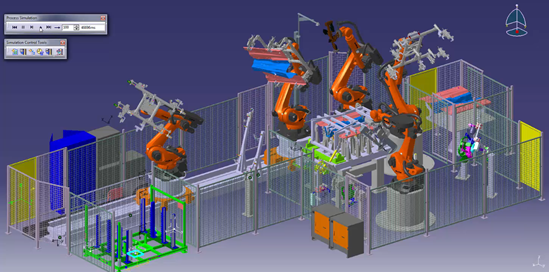
- Design of automated machines and robotic cells using virtual prototyping tools at the factory level, with a particular focus on Industry 4.0 issues.
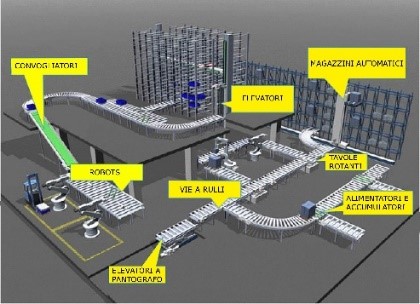
- Smart Factory 4.0: Machine and process emulation; Realistic simulation of factory processes to plan, manage, and control production.
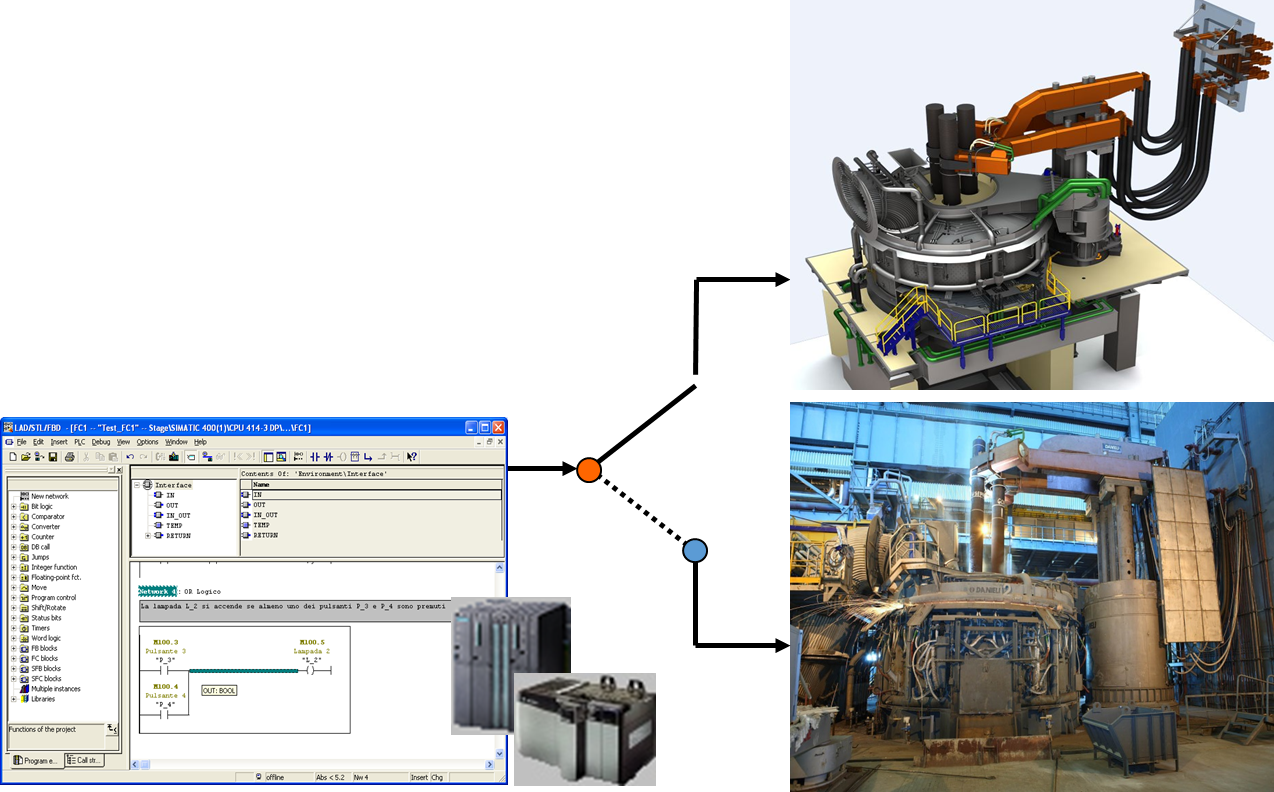
- Digital Shadow & Digital Twin: Virtual models that integrate and participate in the control of physical/real systems.
- Hardware-in-the-Loop (HIL), Software-in-the-Loop (SIL), Model-in-the-Loop (MIL), and Human-in-the-Loop (HITl) simulations.
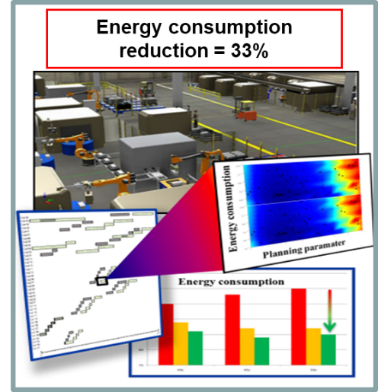
- Eco-sustainable design and energy efficiency in robotic production lines and automated machines for the packaging and pharmaceutical industries.
- Virtual prototyping and testing (virtual commissioning + virtual testing), including methods and tools for coupled multi-domain simulation (mechanical system, actuation system, control auxiliaries).
Laboratories
Mechanical Computer Aided Engineering (MCAELab)
Publications
- M. Gadaleta, M. Pellicciari, G. Berselli, “Optimization of the energy consumption of industrial robots for automatic code generation”, Robotics and Computer-Integrated Manufacturing, vol. 57, pp. 452–464, 2019.
- A. Vergnano, G. Berselli, M. Pellicciari, “Interactive simulation-based-training tools for manufacturing systems operators: an industrial case study”, International Journal on Interactive Design and Manufacturing, Vol. 11(4), pp. 785–797, 2017.
- A. Vergnano, G. Berselli, M. Pellicciari, “Parametric virtual concepts in the early design of mechanical systems: a case study application”, International Journal on Interactive Design and Manufacturing, Vol. 11(2), pp. 331–340, 2017.
- P. Fanghella, A. Sintich, “Multibody modelling of a high speed routing system for automated letter handling”, Mechanics Based Design of Structures and Machines, vol. 40(4), pp. 400–413, 2012
- G. Berselli, M. Pellicciari, G. Bigi, R. Razzoli, “Design optimisation of cutting parameters for a class of radially-compliant spindles via virtual prototyping tools”, International Journal of Computer Aided Engineering and Technology, Vol. 11(2), pp. 232–252, 2019