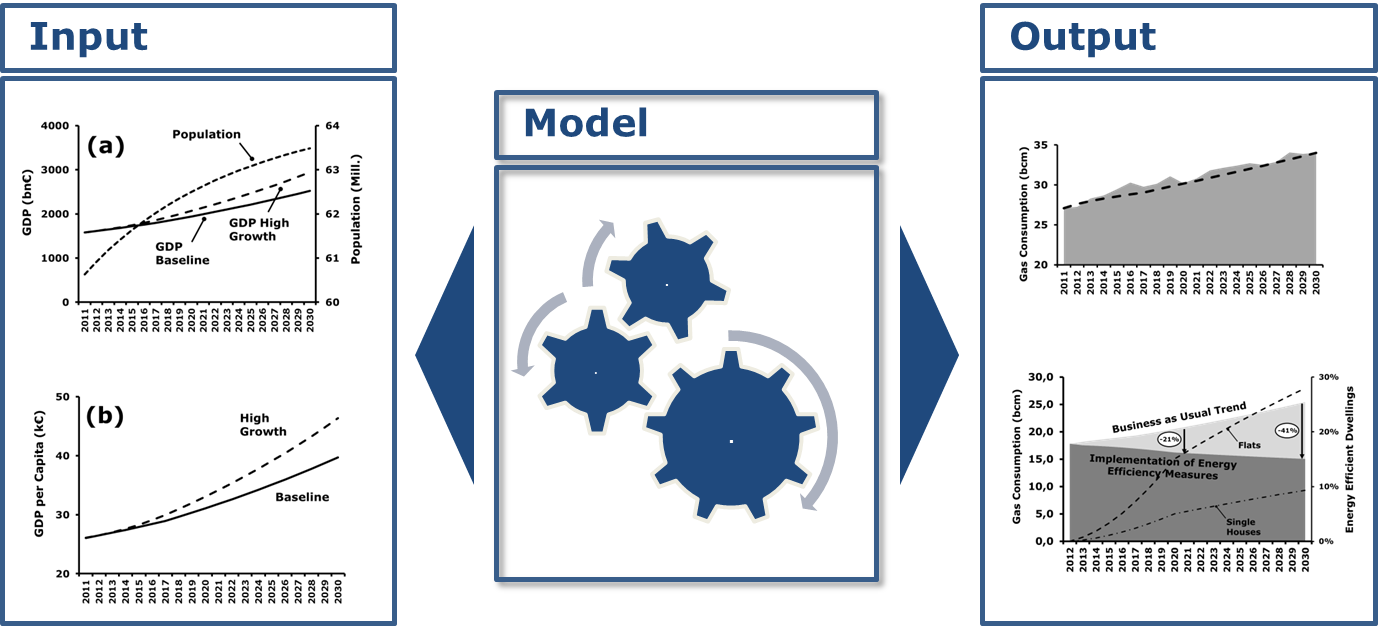

Energy planning involves developing long-term energy scenarios at a local, regional, national, sectoral, or global scale, depending on the desired objective or the specific type of energy being targeted. The objectives of energy planning can be multiple, depending on the context. For example, public authorities may be interested in understanding the quantitative impact of specific energy policies, industrial groups involved in the energy sector may be interested in understanding future demand for a specific type of energy, or in gaining a long-term view of a given energy market. These types of analyses are performed using two different approaches: top-down or bottom-up. The top-down approach involves attempting to correlate a parameter of interest (e.g., energy consumption) with a series of explanatory variables (e.g., GDP – Gross Domestic Product, temperature, population, etc.) in order to find a useful equation for making future projections that are stable over time. The bottom-up approach, on the other hand, involves creating a detailed consumption model, starting with the modeling of individual users, the detail of which depends on the analysis objective. Analysis and experimentation are classic research tools that also find application in activities aimed at rational energy use. Current research activities are focused on the dynamic simulation of systems for energy recovery from unused sources (energy harvesting); and for the evaluation of air conditioning systems for vessels. Development of fire scenario models for tunnel ventilation. Development of fire scenario models for buildings of historical interest.
Topics
- Energy Demand Forecasting
- Energy Market Analysis
- Impact of Energy Efficiency Policies
- Impact of Renewable Energy
- Cost/Benefit Analysis
Researchers
- Federico Scarpa
- Mattia De Rosa
- Augusto Bocanegra
- Annalisa Marchitto
- Francesco Devia
- Davide Borelli
- Corrado Schenone
Involved Laboratories
Laboratory for Analysis and Experimentation on the Rational Use of Energy – Energy Engineering
Representative Publications
- Bocanegra J.A., Scarpa F., Bianco V., Tagliafico L.A. Feasibility of green roofs in the mediterranean region: A stochastic study using a Monte-Carlo financial model. (2024) Energy, 309, art. no. 132995. DOI: 10.1016/j.energy.2024.132995
- De Rosa M., Bianco V., Barth H., Pereira da Silva P., Vargas Salgado C., Pallonetto F. Technologies and Strategies to Support Energy Transition in Urban Building and Transportation Sectors.(2023) Energies, 16 (11), art. no. 4317.DOI: 10.3390/en16114317
- Borelli D., Devia F., Schenone C., Silenzi F., Sollai F., Tagliafico L.A. Assessing environmental benefits of the transition from standard fossil fuels to liquefied natural gas: The Sardinia Region case study (2023) Energy for Sustainable Development, 73, pp. 205 - 217, DOI: 10.1016/j.esd.2023.01.008
- Pierce S., Pallonetto F., De Donatis L., De Rosa M. District energy modelling for decarbonisation strategies development—The case of a University campus. (2024) Energy Reports, 11, pp. 1256 – 1267. DOI: 10.1016/j.egyr.2023.12.048
- Abd Alla S., Bianco V., Scarpa F., Tagliafico L.A. Electrification of the residential heat demand: An analysis of the power market potential to accommodate heat pumps. (2022) Thermal Science and Engineering Progress, 27, art. no. 101173. DOI: 10.1016/j.tsep.2021.101173